
Buying a Villa
in Croatia
What to look for, what to check, what to ignore.
Villas
Position first.
Everything else second.
A villa on the Croatian coast is bought for the view, the water and the privacy. Everything else can be changed.
Villa types
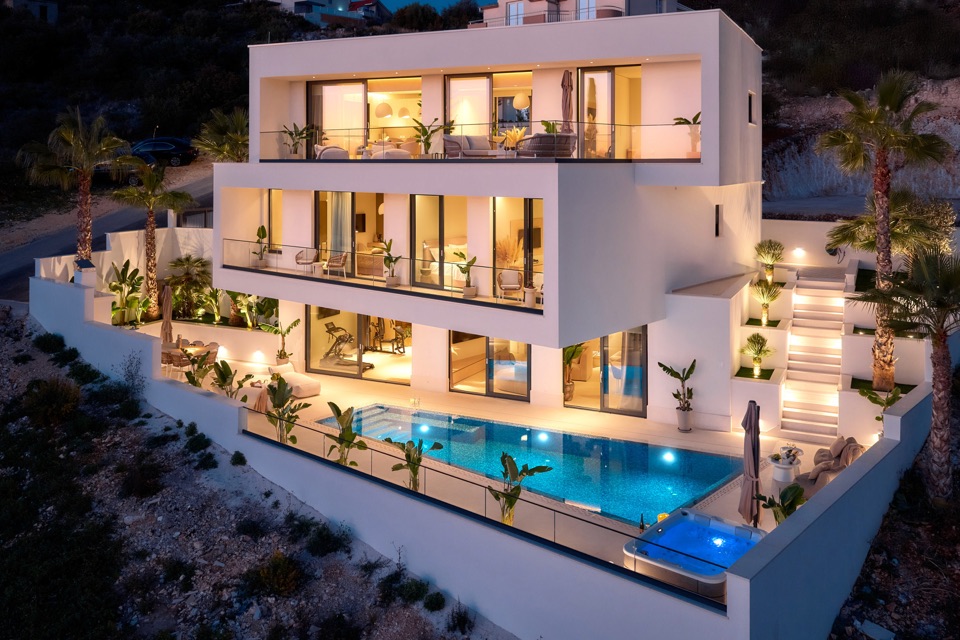
- Contemporary new-build with pool and sea view. 200–450 m², typically €1.2M–4M. The bulk of the market, mostly second row or on the slope behind. Quality varies enormously behind similar photographs.
- First row and beachfront. Rare and mostly off-market, because the law leaves almost no room for new supply. Waterfront explained.
- Serviced resort villas. Managed by a hotel operator, with beach, security and a rental programme. Ownership without the operational burden. An example.
- Stone houses and estates. Character and complexity: shared family ownership, conservation rules and records that often do not match the building. Careful title work comes first.
Where
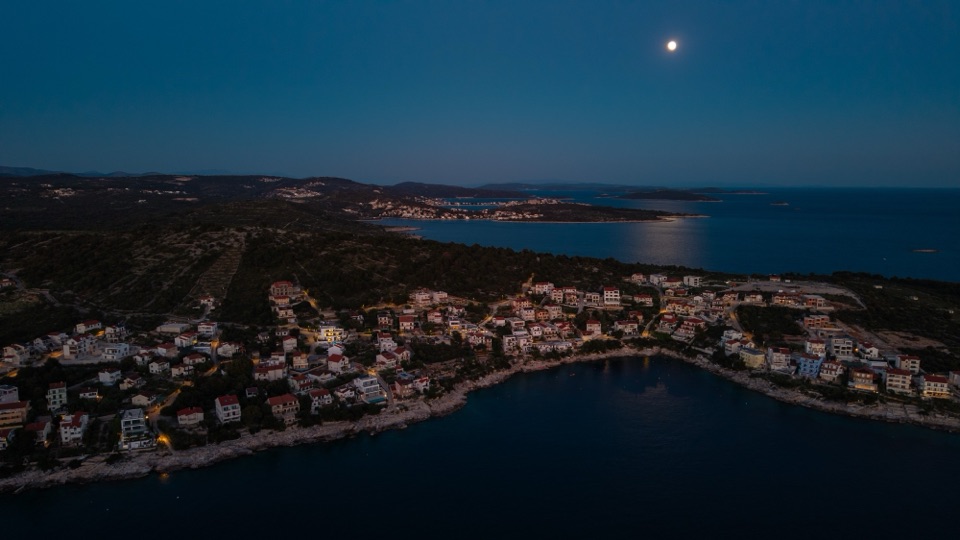
Many international buyers look within 45 minutes of Split Airport: Trogir, Čiovo, Kaštela and the Split Riviera. Dalmatia, market by market.
Due diligence
Six checks
before an offer.
1. The view
A view is only an asset if the land in front cannot be built on. We read the spatial plan for the plots below: zoning, permitted height and coverage.
2. Permits against reality
The building permit, the use permit or a legalisation decision, compared with what stands on the plot: floor area, number of floors and units, pool, outbuildings. Houses completed before 15 February 1968 are treated as lawfully built; later extensions are not covered by that rule. A pool of up to 100 m² needs no building permit, but it does need a design and must respect the spatial plan.
3. Title and access
Land registry and cadastre must match each other and the house. The access road must be public or secured by a registered right of way.
4. Construction quality
Waterproofing of flat roofs and terraces, glazing and sliding systems, pool engineering, drainage, corrosion from salt air, heating and cooling. By law the contractor, the designer and the supervising engineer answer for ten years for defects affecting the essential requirements of a building, and that claim passes to later buyers.
5. Rental economics
Realistic numbers for that micro-location, not a brochure figure. The season is short: June to September accounts for 82% of all overnight stays in Croatia, July and August alone for more than half.
6. The exit
Who buys this from you in ten years, and what does it cost to hold until then?
Owning it
Buy, build
or rent out.
Buy finished or build?
Local plans on this coast typically require a plot of at least 350–400 m² for a detached house, allow it to cover 20–30% of the plot and cap the height at about 7 to 10.5 metres. Official construction prices for new homes are up almost 90% since 2019, and premium construction is currently estimated at roughly €2,200–3,500 per m² before land, design and landscaping. A use permit is required before a new house may be used or let. For most international clients a completed, permitted villa is the lower-risk route. We advise on both.
Renting it out
A holiday house is categorised from two to five stars and needs a rental permit, for which the use permit is a precondition. Private hosts, which means EU, EEA and Swiss citizens with up to 20 beds, pay a flat tax per bed (€70 a year in Trogir, €90 in Okrug Gornji), a tourist-tax lump sum and the annual property tax. Non-EU owners rent through a company. Agency rates for four- and five-bedroom villas with pool in Central Dalmatia start at roughly €2,500–7,000 a week and rise in high summer.
Running costs
Annual property tax of €0.60–8.00 per m² depending on the municipality, pool and garden care, insurance, utilities and a manager if you are not here. Salt, sun and the bura wind mean exterior maintenance comes round faster than inland.
Figures as of September 2026. Sources: Building Act and Spatial Planning Act (2025), Obligations Act, spatial plans of Okrug and Podstrana, Croatian Bureau of Statistics, Eurostat, Croatian Tax Administration, published agency rates. General information, not legal or tax advice.
FAQ
Questions we are asked
How much does a luxury villa in Croatia cost?
New-build sea-view villas with pool in Central Dalmatia are typically offered between €1.2M and €4M. First-row villas are priced by position rather than by size. The top public listings on the coast ask €4M to €6M, and the rarest estates are sold privately.
Can I rent my villa out?
Yes, with a rental permit. EU, EEA and Swiss citizens can rent as private hosts and pay a flat tax per bed; owners from other countries use a company. Split-Dalmatia records more nights booked through rental platforms than any other county in Croatia, but the season is concentrated in four months.
Buy finished or build?
For most international clients a completed villa with a use permit is the lower-risk route: construction costs have risen sharply and permits take time. Building makes sense for a rare plot in a protected position. We advise on both.
What is a use permit and why does it matter?
The use permit confirms that a house was built in line with its building permit. Without it a new house may not legally be used and no rental permit can be issued. For houses built before 15 February 1968 and for legalised buildings, equivalent documents apply.
Can a non-EU citizen buy a villa?
Yes, where reciprocity exists and with the consent of the Ministry of Justice, which typically takes several months. This covers the UK and most US states; Canadians and Australians are temporarily restricted. A Croatian company is an alternative for most non-EU buyers. With Croatia’s full OECD membership, which is expected soon, citizens of all OECD member states will be able to buy on the same terms as Croatians. Details here.
What does it cost to run a villa?
Budget for annual property tax (up to €8 per m² in the most expensive municipalities), pool and garden maintenance, insurance, utilities and property management. If you rent it out, add the flat tax per bed, tourist tax and agency commission.
Tell us the villa you have in mind.
We will tell you whether it exists, and whether it is for sale.