
Dalmatia:
Split to Primošten
The region we live and work in, market by market.
Dalmatia
Where the coast
concentrates.
Our office is in Kaštela, ten minutes from Split Airport. Every mainland market below is within ninety minutes.
Dalmatia has the airport, the islands, the UNESCO towns and the longest season. It also has the strictest planning, which is why supply of the right assets is so limited.
Split-Dalmatia County recorded 20.9 million overnight stays in 2025, about a fifth of all tourism in Croatia. Three UNESCO World Heritage Sites lie in the county: Diocletian’s Palace in Split, the old town of Trogir and the Stari Grad Plain on Hvar.
Trogir and Čiovo
A UNESCO old town on an islet, three marinas and the island of Čiovo across the bridge, six kilometres from the airport. This is the villa market of the region: contemporary houses with pools on the south side of Čiovo, first-row houses in Slatine, Arbanija and Seget. Trogir in depth.
Split and the Riviera
Croatia’s second city: 160,000 residents, a university, the largest hospital in Dalmatia and the country’s busiest passenger port. Urban apartments and penthouses in Meje, Bačvice, Firule and Žnjan, villas towards Podstrana and Omiš. The highest achieved apartment prices in Croatia and a market that works all year. Split in depth.
Kaštela
Seven historic settlements along the bay between Split and Trogir, with 38,000 residents, a 420-berth marina and the airport itself. Prices are roughly a third below Split, for the most central position in the region. Annual property tax is at the legal minimum.
Primošten and Rogoznica
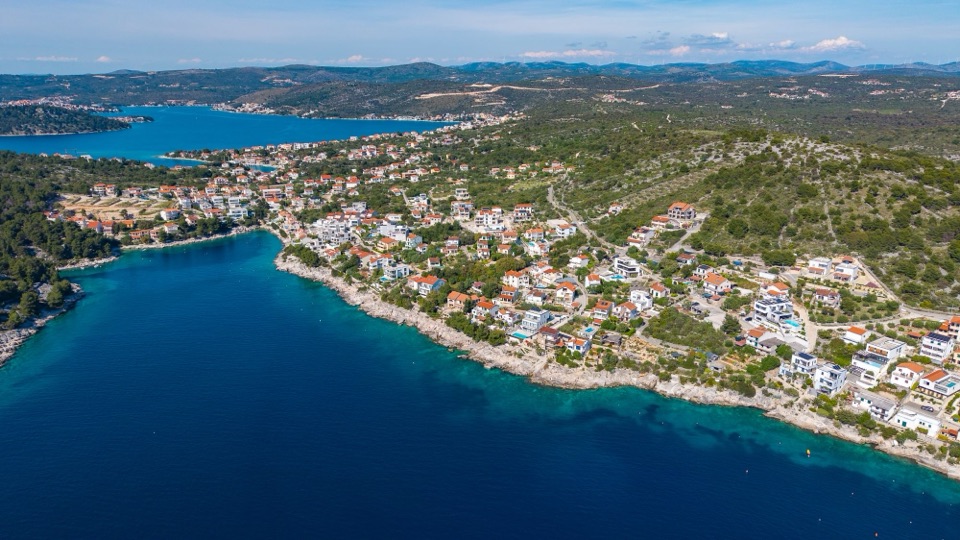
Across the county line towards Šibenik. Primošten is a former island joined to the mainland, with the stone-walled Bucavac vineyards behind it. Rogoznica has 54 km of coves and Marina Frapa. Fewer than a quarter of homes here are lived in all year, and new supply is very limited.
Makarska Riviera
Sixty kilometres of pebble beaches beneath Biokovo, from Brela to Gradac. Strong summer demand, but about ninety minutes from the airport and more seasonal.
The islands
Brač is 50 minutes from Split by ferry, Šolta an hour, Hvar town an hour by catamaran, Vis two hours and twenty minutes. Island property is rarer and less liquid, and building and maintenance cost more. The best of it is mostly sold privately.
Access
Ten to ninety
minutes away.
Split Airport sits in Kaštela, between Split and Trogir. It handled a record 3.88 million passengers in 2025 and gained a seasonal direct flight from New York in 2026.
| From the airport | Distance | Drive |
|---|---|---|
| Trogir | 6 km | 10 min |
| Split centre | 23 km | 25–40 min |
| Podstrana | 27 km | 30 min |
| Rogoznica | 33 km | 35 min |
| Primošten | 38 km | 40 min |
| Omiš | 42 km | 45 min |
| Šibenik | 55 km | 50 min |
| Makarska | 78 km | 90 min |
Times are approximate, with two caveats. In July and August traffic on the coast road can double these times. And the airport is seasonal: June to September carries about 70% of its passengers, while January sees fewer than 40,000. Owners who come in winter often fly via Zagreb or drive; the A1 motorway reaches Zagreb in about four hours.
Markets
Dalmatia,
street by street.
Trogir
UNESCO old town, ten minutes from the airport. The anchor of our activity.
Čiovo
The island opposite Trogir. Villas, first-row plots and quiet bays.
Split
Dalmatia’s capital. Urban apartments, penthouses and the Riviera towards Podstrana.
Kaštela
Seven historic settlements along the bay between Split and Trogir. Where our office is.
Primošten
A stone peninsula town with strict planning and very limited new supply.
Rogoznica
Marina Frapa and a coastline of coves. First-row houses and plots.
Makarska
Riviera villas beneath Biokovo. Strong rental economics.
Šibenik & Zadar
Northern Dalmatia. Waterfront and development opportunities at earlier pricing.
Vis & the islands
Brač, Hvar, Šolta, Vis. Rare, illiquid and mostly off-market.
Opatija
Kvarner. Belle-époque villas for clients who prefer the north.
Choosing
Three questions
of location.
Year-round or seasonal?
In Split, 72% of homes are lived in all year. In Kaštela it is 62%, in Trogir 46%, in Makarska 44%, in the town of Hvar 29%, in Okrug on Čiovo 18% and in Rogoznica 12%. That figure, from the 2021 census, tells you what a place is like in January and how deep the local buyer pool will be when you sell.
How liquid is it?
Sales in Split-Dalmatia County fell by almost a quarter in 2025 while prices kept rising. Well-priced property in established locations still sells; overpriced property in secondary positions waits.
What will it cost to hold?
Annual property tax is set by each municipality. In 2026 it is €0.60 per m² in Kaštela, €2 in Trogir and Seget, €3 in Hvar, about €4 in Rogoznica and Primošten, €5 in Split and Makarska, and €4–8 in Okrug. For a 300 m² villa that is €180 a year in Kaštela and up to €2,400 in Okrug.
Figures as of September 2026. Sources: Croatian Bureau of Statistics (census 2021, tourism 2025), Croatian Tourist Board, Split Airport, Croatian Tax Administration, Ministry of Physical Planning (real estate market review 2025). General information, not legal or tax advice.
FAQ
Questions we are asked
Which part of Dalmatia has the best long-term value?
Positions that cannot be replicated: protected sea views near Trogir and Split, first row on Čiovo, in Primošten and Rogoznica, and old-town stone houses. Planning law makes new supply in these positions close to impossible.
How far is everything from Split Airport?
Trogir and Kaštela about 10 minutes, Split 25 to 40, Rogoznica 35, Primošten 40, Šibenik 50, Makarska about 90. Allow more in July and August.
Is Dalmatia a good rental market?
Demand is strong but concentrated: June to September accounts for more than 80% of overnight stays in Croatia. Short-term rental needs a permit, a flat tax per bed (€70 in Trogir and Kaštela, up to €250 in central Split) and, in apartment buildings, the consent of the co-owners. Economics vary sharply by micro-location; we model them per asset.
Which towns are alive in winter?
Split, and with it Kaštela and Trogir, which are part of the same urban area. The Makarska Riviera, Primošten, Rogoznica and the islands are much quieter from November to March.
Are there direct flights?
In summer Split is connected to most of Europe, and since 2026 there is a seasonal direct flight from New York. In winter only a small number of routes operate, so many owners connect through Zagreb.
Local intelligence, on your side.
Tell us where you are looking.